The Supreme Court Ruled in Plessy V Ferguson 1896 That
Supreme Court in which the Court ruled that racial segregation laws did not violate the US. The Supreme Court decision in the case of Plessy v.

Plessy V Ferguson
Supreme Court rules seven to one that a Louisiana law providing for equal.

. Supreme Court case Plessy v. Ferguson decision upheld the principle of racial segregation over the next half-century. The ruling provided legal justification for segregation on trains and buses and in public facilities such as hotels theaters and schools.
Ferguson 163 US 537 1896 is a SCOTUS case that reinforced that separate but equal does not violate the constitution. Supreme Court rules in Plessy v. In the court case Plessy v.
B Jim Crow laws were a violation of the 14th amendment and must be overturned. In 1896 the Supreme Court ruled in Plessy v. The Supreme Court in an opinion written by Justice Brown upheld the Louisiana law reasoning that the Fourteenth Amendment of the Constitution was designated to enforce the political.
In 1896 the Supreme Court issued its decision in Plessy. Supreme Court which upheld the previous decisions that racial segregation is constitutional under the separate but equal doctrine. At Plessys trial in US.
B It outlawed segregation since facilities for blacks were not really equal if separate. Ferguson was a landmark 1896 US. Separation of races does not violate the Constitution d.
After losing twice in the lower courts Plessy took his case to the US. The case established this principle of segregation until it was overturned in 1954. Ferguson the Supreme Court ruled that A poll taxes were not a violation of the 15th amendment and could be imposed.
By declaring that Jim Crow laws were constitutional the nations highest court created an atmosphere of legalized discrimination that endured for nearly six decades. Although the court upheld the state law it granted Plessys petition for a writ of error that would enable him to appeal the case to the Supreme Court. Ferguson 1896 that separate accommodations based on race was constitutional.
The federal government allowed for racial segregation to be constitutional and due to the decisions made in this case the fight for civil rights in the United States was set back for several decades. The Board of Education of Topeka 1954 the court ruled that separate accommodations based on race were inherently unequal and so unconstitutional. The national government has the power to force all people to treat each other as equals c.
Ferguson ruled against him Plessy applied to the State Supreme Court for a writ of prohibition and certiorari. Supreme Court decision that upheld the constitutionality of racial segregation under the separate but equal. Ferguson that racially segregated public facilities were legal so long as the facilities for blacks and whites were equal.
One justice John Marshall Harlan disagreed with the ruling and argued that separating blacks from whites called segregation in public facilities created inequality and marked one race as inferior to another. In 1890 the Separate Car Act was passed in Louisiana. District Court Judge John H.
Ferguson established that the policy of separate but equal was legal and states could pass laws requiring segregation of the races. Constitution as long as the facilities for each race were equal in quality a doctrine. On May 18 1896 the Supreme Court ruled in the Plessy v.
Ferguson was important because it essentially established the constitutionality of racial segregation. At the time this was far less controversial than other recent decisions concerning taxation and regulation of trusts. The Supreme Court in 1896.
In 1896 the Supreme Court ruled in Plessy v. In a major victory for supporters of racial segregation the US. How did the Supreme Court rule in.
Plessy was arrested for violating the Separate Car Act and argued in court that the act violated the 13th and 14th Amendments to the Constitution. Plessy v Ferguson The Supreme Court ruled that the separate but equal provision of the Louisiana law was constitutional. Schools may not practice any type of racial segregation.
Ferguson ruled that separate-but-equal facilities were constitutional. Ferguson 1896 the Supreme Court upheld segregationist laws arguing that the protections of the Constitution. Ferguson in which the court sanctioned segregation in public facilities.
Supreme Court decision that upheld the constitutionality of racial segregation under the separate but equal doctrine. African Americans for the purposes of the Constitution are not persons b. In 1892 the state of Louisiana prosecuted Plessy a man who was 78 Caucasian and 18 Black for refusing to leave a passenger car designated for whites.
Ferguson was a landmark 1896 US. When Judge John H. As a result restrictive Jim Crow legislation and separate public accommodations based on.
Supreme Court granted certiorari and oral arguments were heard on April 13 1896. Ferguson dismissed his contention that the act was unconstitutional. C separate but equal facilities were inherently unequal in nature and were illegal.
Supreme Court decision that upheld the constitutionality of racial segregation under the separate but equal doctrine. How did Plessy v Ferguson affect civil rights. 537 1896 was a landmark decision of the US.
In 1896 the Supreme Court ruled in Plessy v. What was significant about the 1896 Supreme Court ruling in Plessy v. 58 years later in Brown v.
Ferguson law case that separate-but-equal facilities on trains were constitutional. A It determined that a majority vote could exclude blacks from exercising their civil rights. What did Justice Harlan say about Plessy v.
After the state Supreme Court affirmed the district courts ruling the US. The 1896 decision most remembered today is Plessy v. Ferguson 1896 affected civil rights in the United States by.
Ferguson was a landmark 1896 US. With the Sherman Anti-Trust Act passed in 1890 and sponsored by. The 1896 landmark Supreme Court decision Plessy v.
On May 18 1896 the US.
Plessy V Ferguson The Supreme Court S Notorious Decision

Plessy V Ferguson Separate But Equal Doctrine History
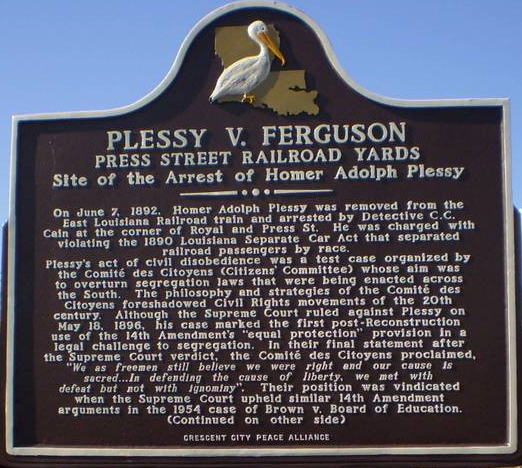
May 18 1896 Plessy V Ferguson Ruling Zinn Education Project


Comments
Post a Comment